Salesforce homepage. Three heroes, one fold.
The 50-millisecond verdict lands clean. The brand registers, the category registers, “#1 Agentic CRM” lands. Then the page spends the next three seconds showing the visitor a CRM-pitch hero, an embedded Agentforce chatbot, and a four-product Agentic Enterprise band, all stacked inside a single 1920×1080 fold. Twenty-six chunks of decision-shaped content above the scroll, against a working-memory ceiling of three to five.
Brand lands. Then the thesis splits.
The very top of the page is clean. Salesforce wordmark in the upper-left, hero headline reading “Get started with the #1 Agentic CRM,” two CTAs, on-brand blue. Lindgaard et al. (2006) give the visitor 50 milliseconds to form a verdict; the visitor forms it cleanly: this is Salesforce, this is enterprise CRM, this is on-brand. The 50ms layer scores Strong.
The next three seconds are where the page diverges from itself. Within the same fold, no scroll required at 1920×1080, the page restages as an Agentforce chatbot ("Product needs? Pricing questions? Ask away.") with its own headline and three chip-prompts, and again as the dark-blue "Welcome to the Agentic Enterprise" band with four product cards. Three theses, one fold. The visitor's information-foraging pass (Pirolli & Card, 1999) stalls because every direction looks equally important and none looks like the direction.
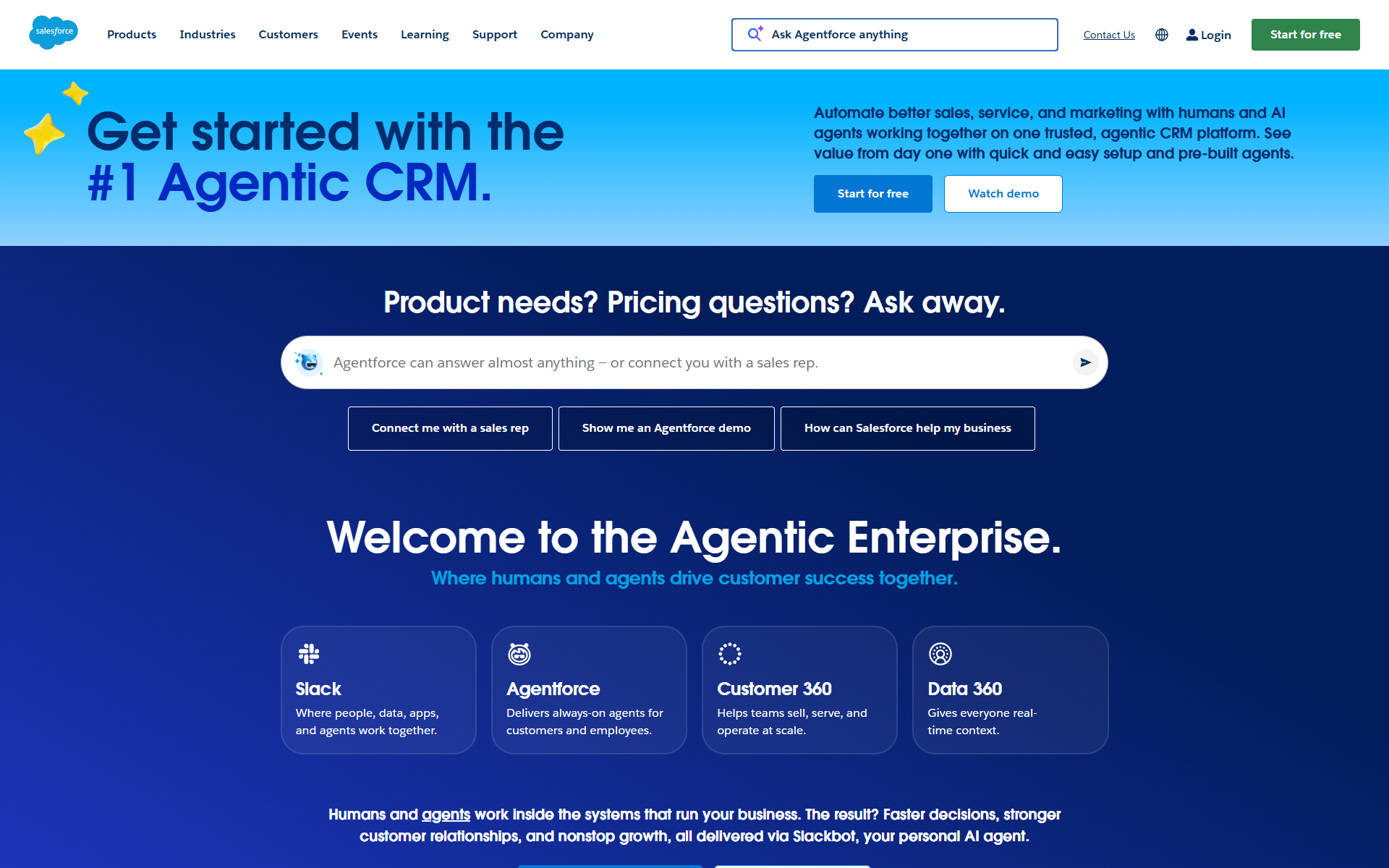
audits/salesforce/assets/homepage.html.Layer-by-layer diagnosis.
| Layer | Score | Why this score |
|---|---|---|
| L0. Cognitive Load | 32/100 | 26 chunks above the fold (nav: 11, hero: 4, chatbot: 5, Agentic Enterprise band: 6) against a Cowan (2010) working-memory ceiling of 3 to 5. Nine roughly equal-weight primary CTAs at the same depth. Page asks for five times the working memory the visitor has. Primary failure layer. |
| L1. First Impression | 70/100 | Brand registers fast, on-brand visual quality, no uncanny-valley triggers. The 50ms verdict is clean. The thesis splits within the first fold (CRM-pitch → chatbot → Agentic Enterprise), which keeps L1 at the lower end of Strong (capped from raw 72 by L0 cascade). Lindgaard 2006; Kurosu & Kashimura 1995; Leder 2004. |
| L2. Processing Fluency | 52/100 | Five Agent-prefixed coinages in three folds (Agentic, Agentforce, Agentic CRM, Agentic Enterprise, AgentBlazer), plus parallel "humans and agents" body copy. Five distinct blues and two greens visible in the fold without reserved semantic roles. Reber & Schwarz 1999; Bujack 2022. Color collision and lexical density compete for attention budget. |
| L3. Perception Bias | 50/100 | "#1 Agentic CRM" claim sits in the hero with no in-fold source citation. Customer logos and case studies sit below the trust-decisive scroll depth, three folds down. Per Cialdini 2001 and Seckler 2015, social proof works best co-located with the claim it substantiates. The autopilot encodes the claim before the substantiation arrives. |
| L4. Decision Architecture | 48/100 | Eleven roughly equal-weight entry points in fold 1 (2 hero CTAs + chatbot input + 3 chip-prompts + 4 product cards + nav CTA). Pirolli & Card 1999 information-scent works when one scent dominates. Eleven equal-weight scents is a flat-line. The Agentforce chatbot pre-empts the visitor's evaluation pass with the largest single click-target on the page. Alignment partial, Sincerity partial, Golden Rule fail by inference. |
| Overall | 50/100 | Cascade-capped, weighted (L0 0.25, L1 0.20, L2 0.20, L3 0.15, L4 0.20). L0 < 50 caps L1–L4 at 70; L1 raw 72 capped to 70. Hard floor (any layer <30 caps Overall at 55) not triggered, L0 is 32. Pattern-class observations in the dark-pattern map don't trigger the 70 ceiling because Overall is below 70 already. Primary failure: L0 Cognitive Load. Fix order: L0 → L4 → L2. |
Layer definitions and scoring: Cowan 2010 (L0); Lindgaard et al. 2006, Kurosu & Kashimura 1995, Leder 2004 (L1); Reber & Schwarz 1999, Alter & Oppenheimer 2009, Bujack 2022 (L2); Cialdini 2001, Nisbett & Wilson 1977, Seckler 2015 (L3); Pirolli & Card 1999, Hertwig & Erev 2009, Thaler & Sunstein 2008 (L4). Pattern-class observations named in the FTC's 2022 Bringing Dark Patterns to Light report and Brignull's deceptive.design/types taxonomy. Captured 2026-05-09. Full audit at audits/salesforce/audit.md.
Twenty-six chunks vs six.
Cowan's 2010 working-memory research is the clearest constraint we have on what a visitor can hold while reading a webpage: between three and five chunks. Salesforce's homepage asks for twenty-six in the first fold. The page is structured as a directory of equally-prominent paths, none of which is the path. My take: a homepage with one thesis lets the visitor finish forming a model of the company before being asked to interact with it.
Before. Above-the-fold, 1920×1080
Hero (4 chunks): headline, subhead, Start for free, Watch demo.
Agentforce chatbot (5 chunks): heading, input field, Connect me with a sales rep, Show me an Agentforce demo, How can Salesforce help my business.
Agentic Enterprise band (6 chunks): heading, subhead, Slack, Agentforce, Customer 360, Data 360.
Total: 26 chunks. Cowan ceiling: 3–5.
After. My take
Single hero (3 chunks): "Salesforce is the CRM you build your business on." Sales, service, marketing, commerce, and AI agents on one platform. Start free · See pricing.
One next decision below the fold: "What part of your business do you want to fix first?" 5 cards: Sales, Service, Marketing, Commerce, AI Agents.
Chatbot becomes a small persistent FAB (bottom-right), opt-in, available after the visitor has formed a model of Salesforce. Available to the visitor, not gating the visitor.
Total: 6 chunks. Cowan ceiling: 3–5. Pretty close.
The rebuild, live
"One thesis per fold." Single hero, ranked CTAs, navigation surface below, chatbot demoted to opt-in FAB.
The fix, in priority order: L0 chunk reduction, fold-level chunks from 26 to ~6 by collapsing the three competing heroes into one. L4 information scent, two ranked CTAs in the hero plus a five-card “What part of your business?” navigation surface below, instead of nine equal-weight entry points. L2 reserved color, two blues and one cyan with semantic roles. L3 source-cited authority, the “#1 CRM” claim now reads “#1 CRM by revenue, IDC May 2024” with a link, and named customer logos sit in fold 1 alongside the claim, not three folds down. The rebuild renders Salesforce's own visual aesthetic (their fonts via system fallback, navy / blue-vibrant / cloud-blue palette, captured brand SVGs) so it reads as “what Salesforce could ship” rather than “what Aurochs would build instead.”
If you scrolled this far, I do this for products. Send me a URL.
Send me your URLSame five-layer scoring. 7-day turnaround. Document you keep.