Methodology Work Services Book About Writing Make Me Think - chapters Methods Guide Notes Blog FAQ

Work / 03

03Staging

Matthew Frederick

San Francisco oil painter · forty years of work in oil

A painter’s site that became his catalog: 61 paintings, each with its own page and a way to ask about it.

May to September 2026 · captures taken 2026-10-07 and 2026-10-11
Published with Matthew Frederick’s permission.

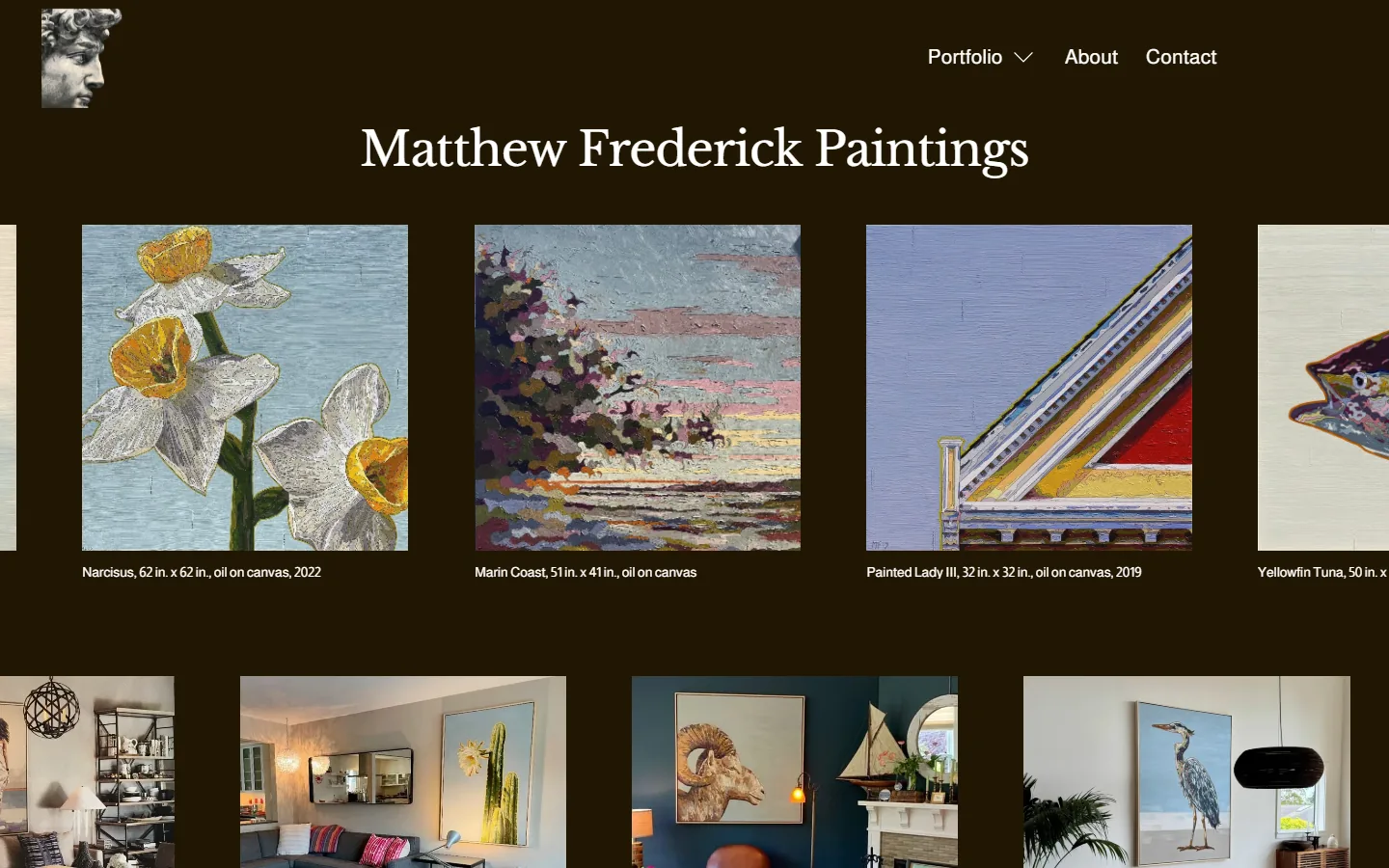
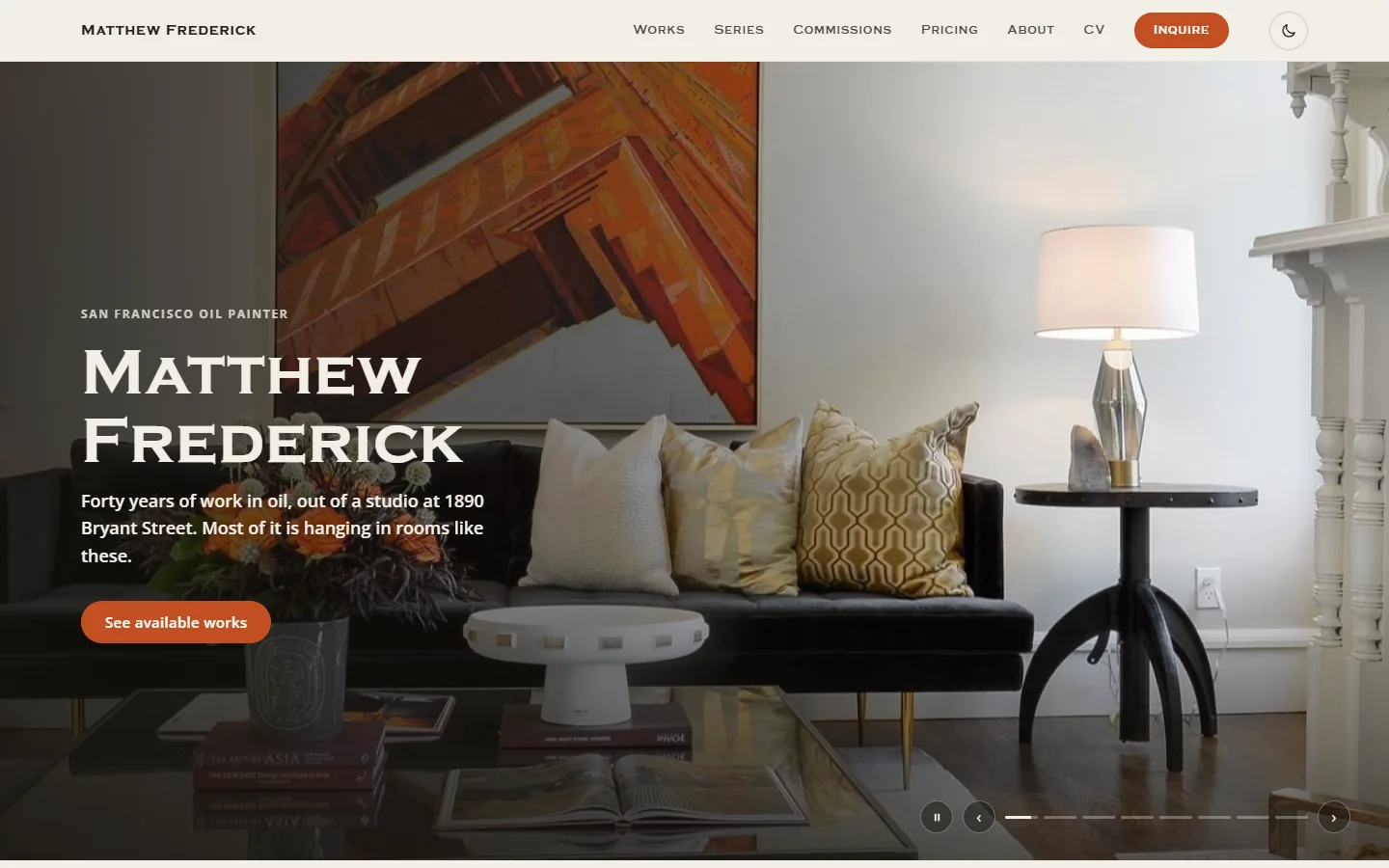
mjfrederickart.com desktop first screen, captured 2026-10-11: a cut-out of his painting David as the logo, Matthew Frederick Paintings as the title, a row of painting thumbnails with captions, and the top of a row of room photographs.The staging site desktop first screen in its day theme: a living room with his painting South Tower Golden Gate above a dark sofa fills the screen; over it, San Francisco oil painter, his name in engraved capitals, a line about forty years of work in oil, and a See available works button.

Left: mjfrederickart.com as it loads today. Right: the staging site, switched to its day theme and on the first room of its slideshow, captured the same day at the same size.

The new site as it stands on staging. It opens in its night theme; its day and night switch shows the day theme used on this page.

What the design aimed for

Pre-verbal arousal: the nervous system registering trust, relevance, and forward momentum before the analytical mind engages.

For Matthew Frederick: a visitor’s first impression lands on “serious San Francisco oil painter, gallery-grade craft.”

Checkpoint 01 · First 50 milliseconds

“What is this, and is it worth my attention?”

The visitor has not read a word yet. In my audit in May, his site’s first impression resolved to “competent Squarespace template,” not “established SF oil painter.”

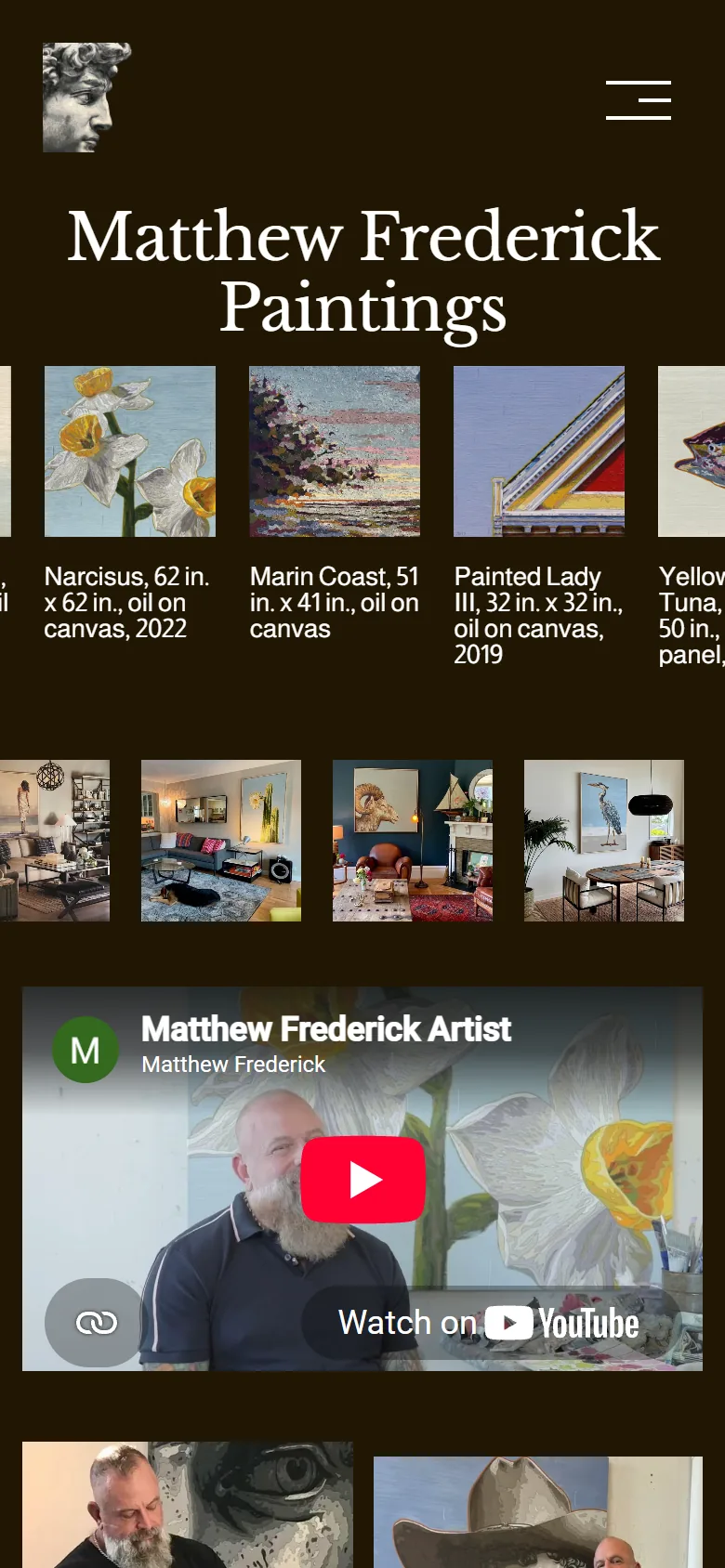
mjfrederickart.com first screen on a phone, captured 2026-10-11: the cut-out logo, Matthew Frederick Paintings, a row of painting thumbnails, a row of room photographs and a video.
Before
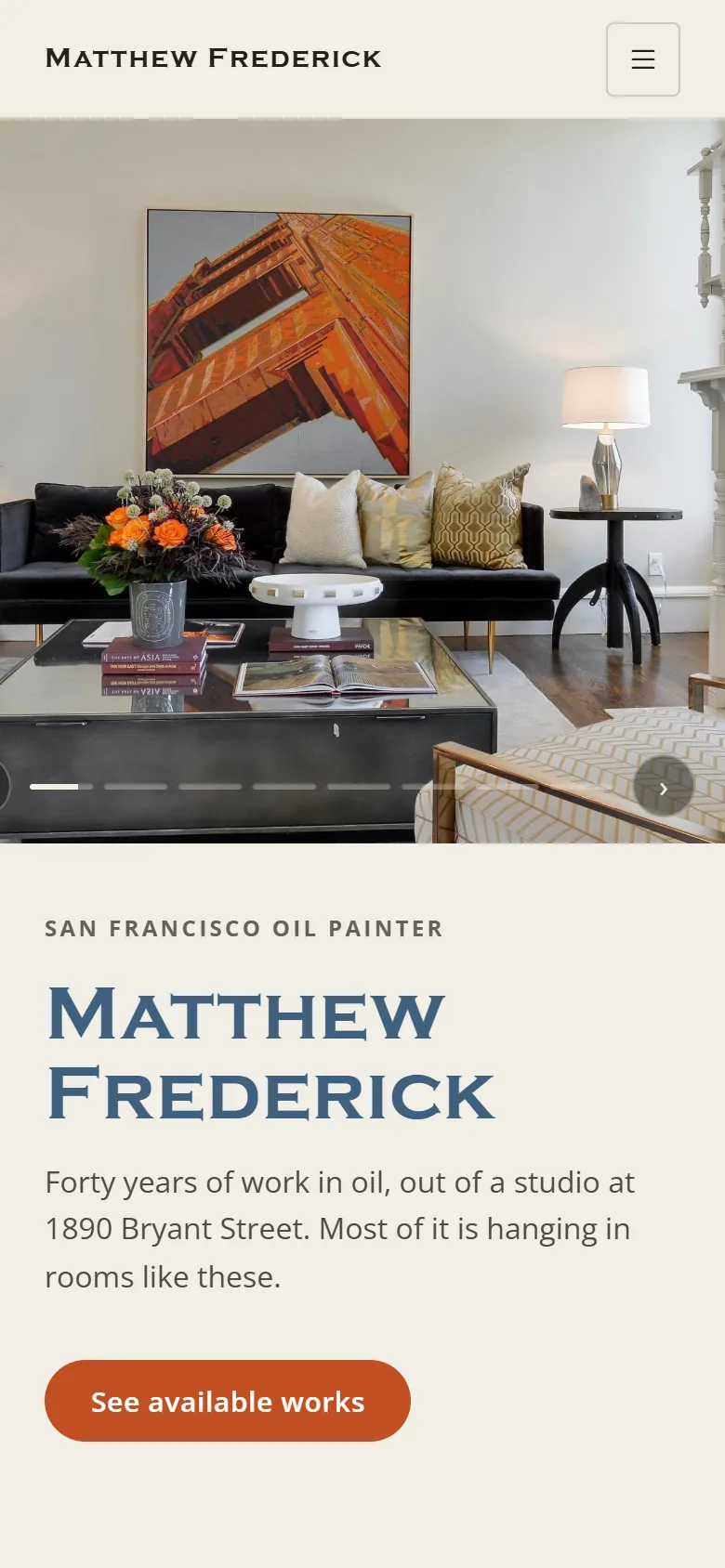
The staging site first screen on a phone, in its day theme: the living room with his South Tower Golden Gate painting above the sofa, then San Francisco oil painter, his name, the line about forty years of work in oil, and See available works. Gold markers 1 and 2 point at the painting and at his name.
After

The same two first screens on a phone, captured 2026-10-11; the staging site in its day theme.

Decisions

1

The paintings in the rooms they hang in

L1 First-Impression Architecture

Clear the fifty-millisecond trust gate so attention switches on at all.

A photograph from his own Instagram fills the first screen, so the first thing a visitor sees is the work installed rather than the work isolated: his South Tower Golden Gate, in a collection in Seattle. On a phone the room comes first, with the words beneath it.
2

His name, set in the face he chose

L1 First-Impression Architecture

Clear the fifty-millisecond trust gate so attention switches on at all.

On his site today, the header logo is a cut-out of his painting David. Here his name is set in Copperplate, the engraved capitals he chose, in the header and on the first screen.

Paste-ready line

“The painter is the hero, and so are the rooms.”

Checkpoint 02 · First 30 seconds

“Is he established, and what does he paint?”

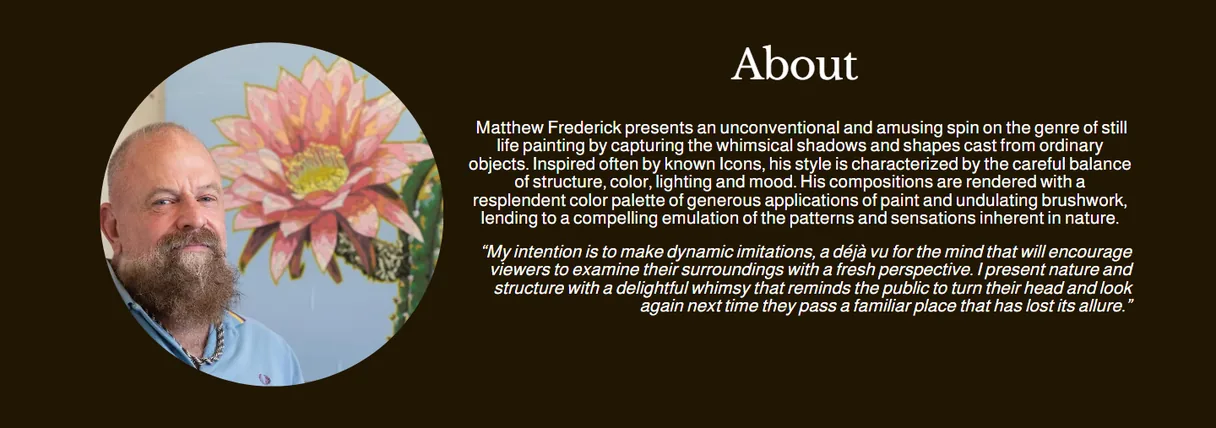
His About page today has a portrait, a paragraph about the paintings and his statement. None of his record is on it: no shows, no gallery, nothing he founded.

mjfrederickart.com About page, captured 2026-10-07: a round portrait, a paragraph about his paintings and his statement in italics.
BeforeHis site today: the About page. Captured 2026-10-07.
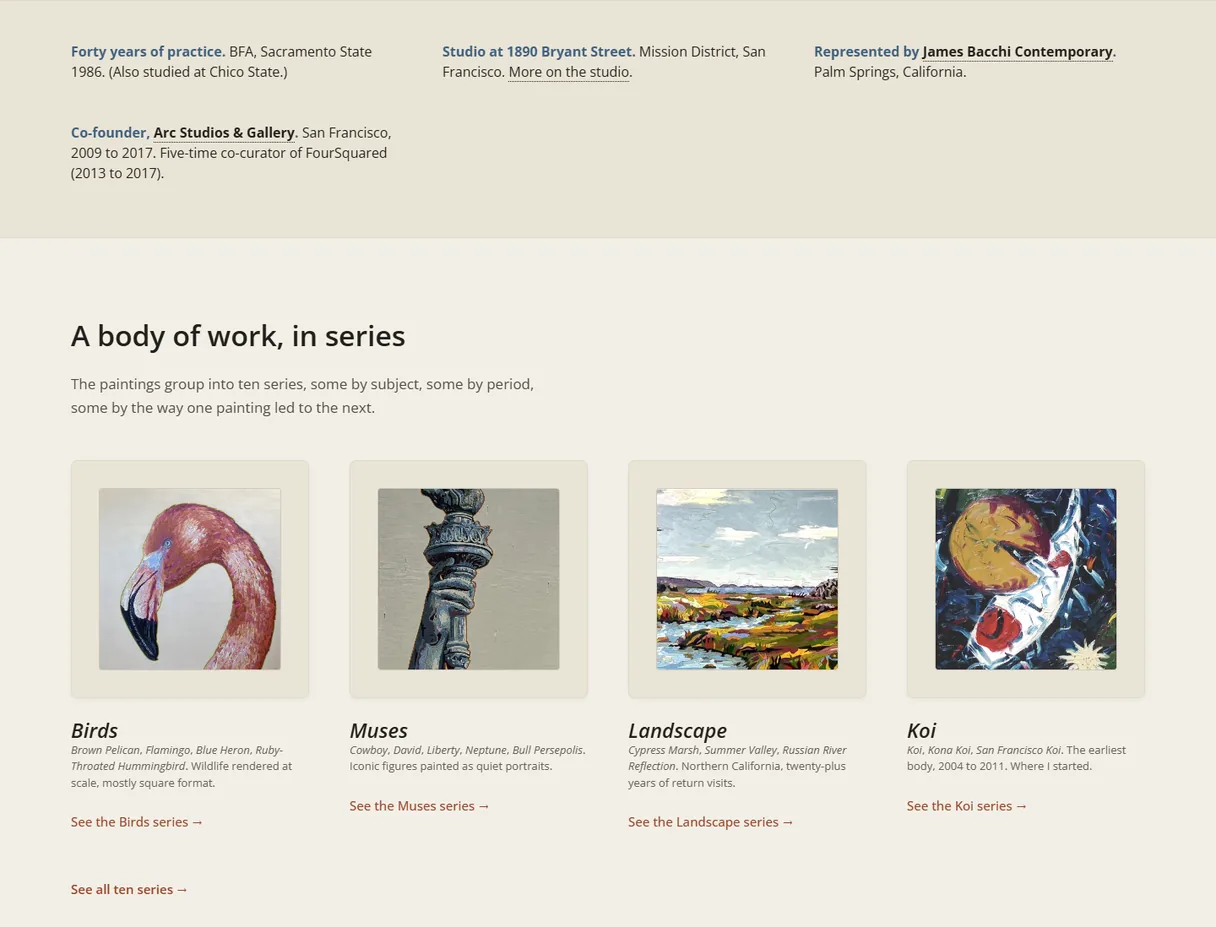
The staging site under its first screen: four lines of his record (forty years of practice, the studio at 1890 Bryant Street, his gallery, Arc Studios & Gallery), then A body of work, in series, with Birds, Muses, Landscape and Koi. Gold markers 1 and 2 point at the decisions below.
AfterThe staging site, directly under the first screen: four lines of his record, then the ten series.

Decisions

1

His record, directly under the first screen

L3 Perception Bias Optimization

Design for what the reader actually does, not what they would say they want in a focus group.

The first screen stays painter-led, and four lines below it carry the record: forty years of practice, the studio, his gallery and the gallery he co-founded. His About page today has none of it.

2

A body of work, in ten series

L0 Cognitive Load

Free the working memory the reader needs to process the page at all.

L2 Processing Fluency

Make the page easy to read so the content feels true.

The 61 paintings group into ten series, some by subject, some by period. Four lead on the home page, each linked to its series.

Paste-ready line

“The gap was perceptual, not factual. The facts were already there. The old site simply had no machinery for showing them.”

Checkpoint 03 · The full session

“Can I buy this one, and how?”

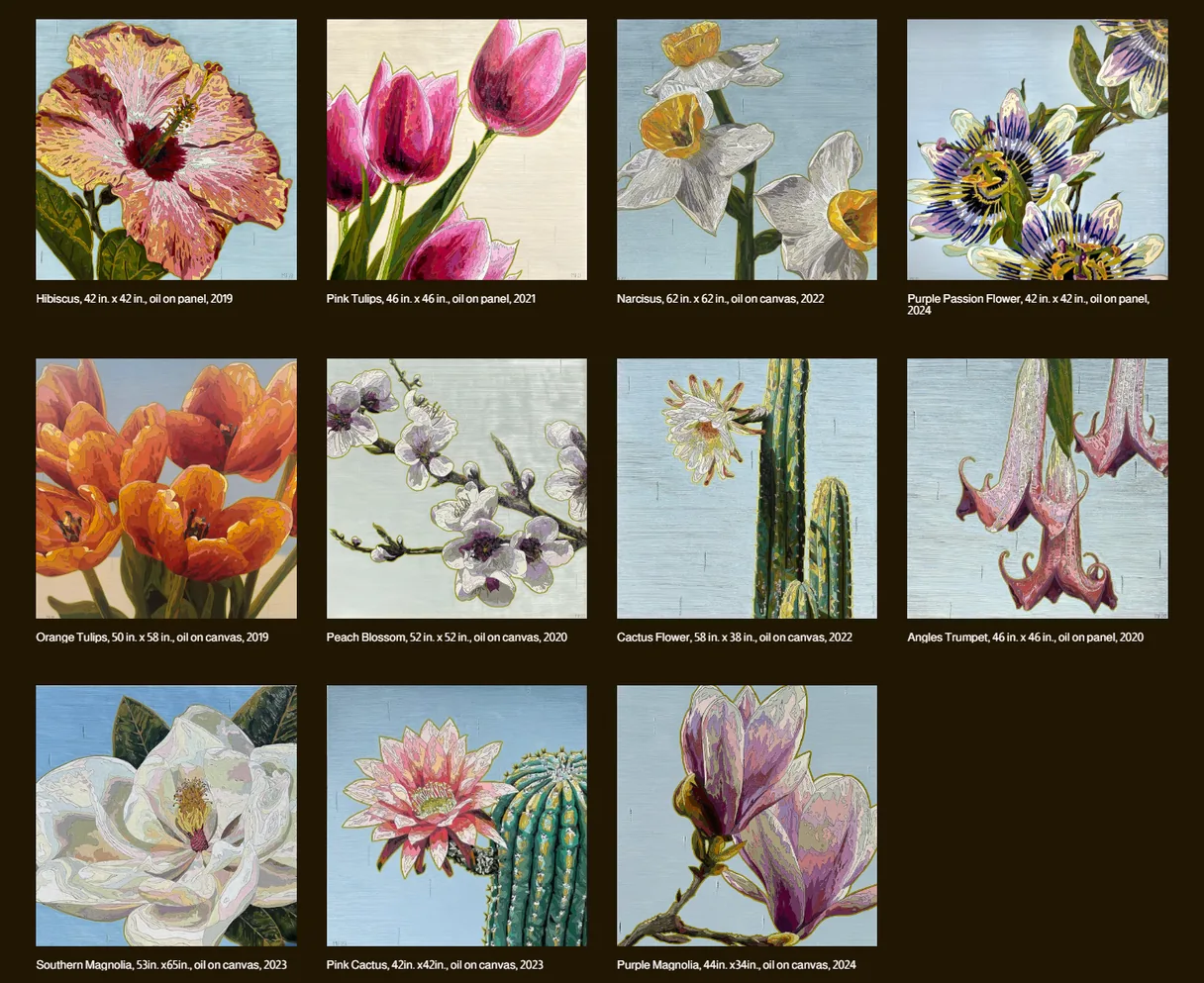
On his site today, Narcissus is one captioned thumbnail among eleven flower paintings. It opens a larger view and nothing more; to ask about it, a visitor finds the contact page.

mjfrederickart.com flower paintings page, captured 2026-10-07: eleven thumbnails with captions, Narcissus third in the first row.
BeforeHis site today: the flower paintings, Narcissus among them. Captured 2026-10-07.
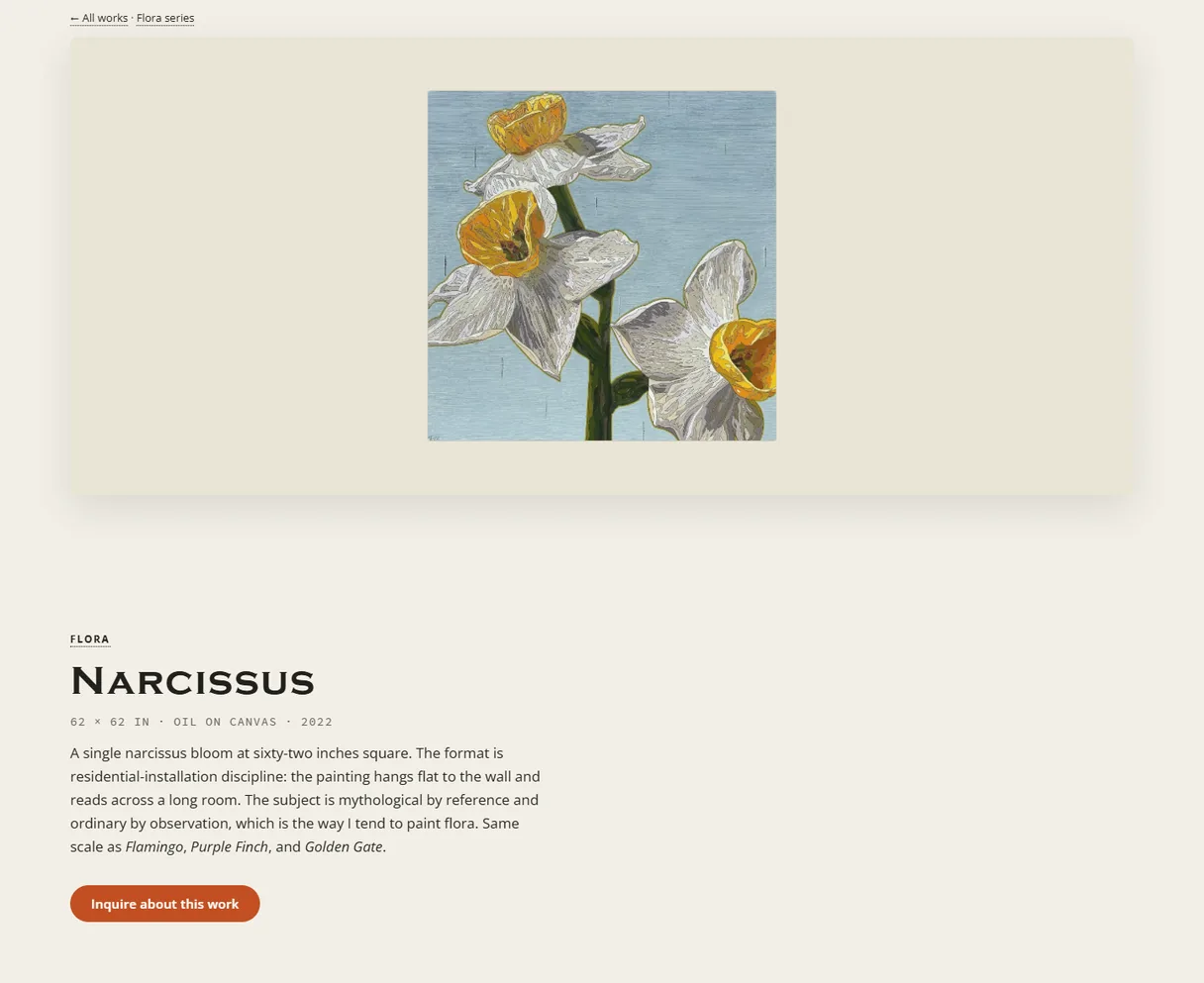
The staging site page for Narcissus: the painting on a linen mat, its title, size, medium and year, a paragraph, and an Inquire about this work button. Gold marker 1 points at the decision below.
AfterThe staging site: the page for Narcissus.

Decisions

1

A page for each painting, with the ask on it

L4 Decision Architecture

Structure the page so the right action is the easiest action.

Each of the 61 paintings has its own page: the painting, its title, size, medium and year, and “Inquire about this work”, which opens the inquiry form.

What should change

A collector should be able to ask about one painting from its own page.

Check after launch: how many inquiries name a painting, in the record the platform keeps of each one.

Paste-ready line

“Inquiry, not cart. The price tier decided the primitive.”

The method

Five layers, with the limits and the research behind eachShow all +Hide
  1. L0 Cognitive Load

    Free the working memory the reader needs to process the page at all.

  2. L1 First-Impression Architecture

    Clear the fifty-millisecond trust gate so attention switches on at all.

  3. L2 Processing Fluency

    Make the page easy to read so the content feels true.

  4. L3 Perception Bias Optimization

    Design for what the reader actually does, not what they would say they want in a focus group.

  5. L4 Decision Architecture

    Structure the page so the right action is the easiest action.

The framework, with its research and its limits

Result

Built on staging, set to replace his current site once he settles his prices and terms.

Paid engagement, signed after he saw the first build.

Perception-First Design™ consulting

For branding, brand development and marketing strategy.

Stefan Kovalik   San Francisco

Send me your site.

I’ll tell you what I’d change. No pitch, just an honest read. If it makes sense to work together, we will.

Weekday response within 48 hours.

I have room right now.