
Amazon Prime cancel. The post-settlement Iliad.
The FTC banned the original four-page Iliad in September 2025. Amazon shipped a one-page replacement that compresses the same dark-pattern intent: a seven-tile sunk-cost carousel, three stacked save offers, a loss-framed bullet box, four iso-styled radios, and two yellow equal-weight action buttons. Captured 2026-05-06 by walking the live flow through to completed cancellation.
Two yellow buttons. Eleven decision elements. One screen.
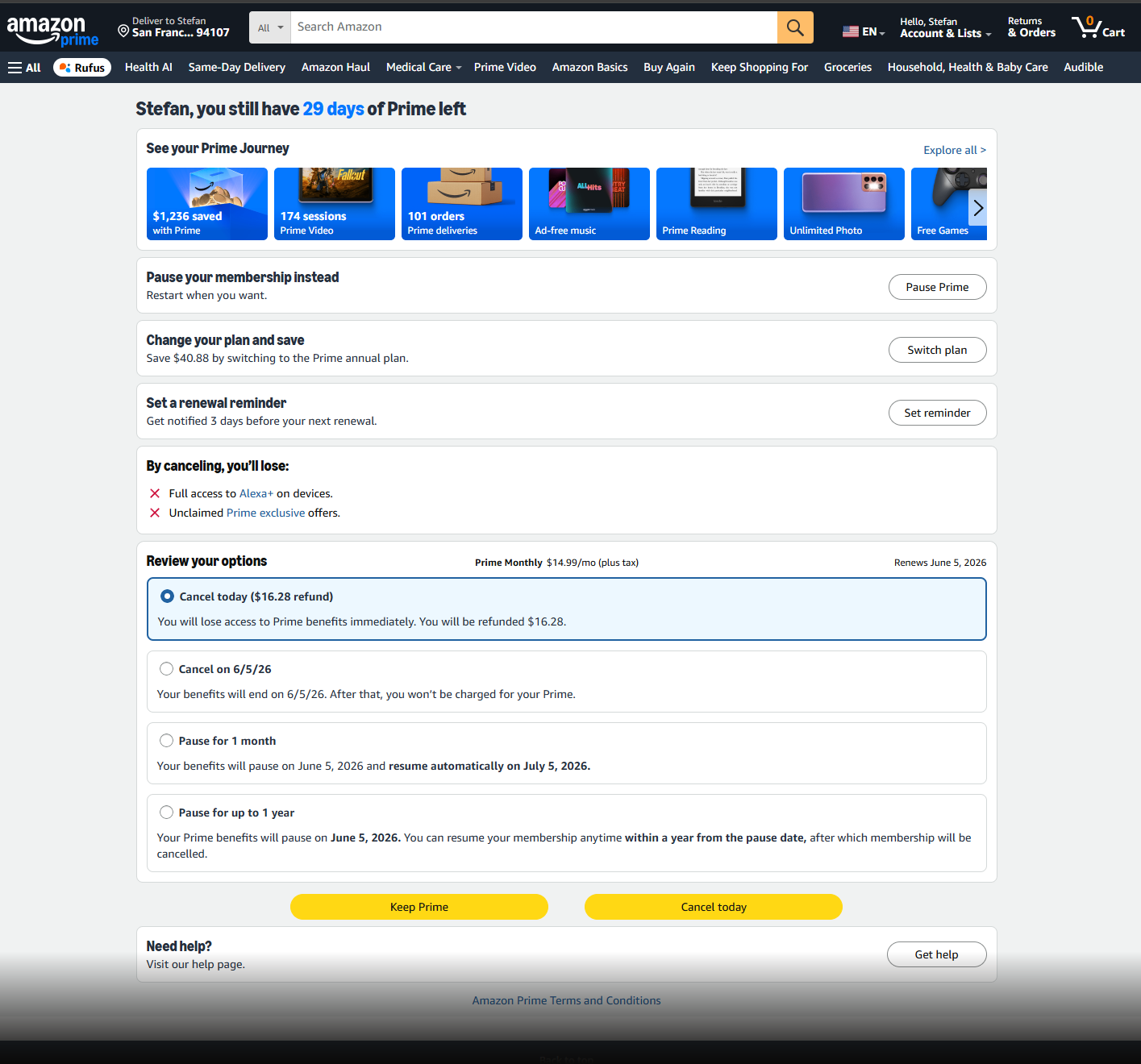
The post-settlement cancel page fires before the visitor reads a word. Two yellow buttons sit side by side at the bottom of the screen, equal chroma, equal weight, equal placement: Keep Prime and Cancel today. The 50ms visual verdict (Lindgaard et al., 2006) cannot locate the cancel affordance any better than it could on the original four-page Iliad. Above them: a seven-tile journey carousel, three save CTAs, a loss-framed bullet box, four iso-styled radios. The dark patterns of the original Iliad did not disappear when the FTC consent order banned them. They were redistributed onto a single screen.
Layer-by-layer diagnosis.
| Layer | Amazon ships | Aurochs rebuild | Why Amazon (still) fails |
|---|---|---|---|
| L0. Cognitive Load | 25/100 | 90/100 | 11+ decision-shaped elements compressed onto a single screen: 7-tile sunk-cost carousel, 3 stacked save CTAs, 1 loss box, 4 iso-styled radios, 2 yellow action buttons. WM hits the Cowan (2010) 3 to 5 chunk ceiling harder per-screen than the distributed Iliad did. Rebuild presents 3 decision elements, well under ceiling. |
| L1. First Impression | 30/100 | 92/100 | Two iso-styled yellow buttons, Keep Prime and Cancel today, equal chroma, equal weight. The 50ms visual verdict (Lindgaard et al., 2006) cannot locate the cancel affordance. Rebuild has one primary visual weight (gold cancel button); escape is link-weight. |
| L2. Processing Fluency | 25/100 | 90/100 | The radio group forces System 2 engagement (Alter & Oppenheimer, 2009) to parse refund math and to distinguish 2 cancel options from 2 pause options that share visual treatment. The Prime Journey carousel is mere-exposure for retention (Zajonc, 1968). Rebuild states the date plainly. Refund detail collapsed below the cancel button. |
| L3. Perception Bias | 20/100 | 88/100 | The See your Prime Journey carousel weaponizes sunk-cost reframing ($1,236 saved, 174 sessions, 101 orders). The By canceling, you'll lose red-X box is loss aversion (Kahneman & Tversky, 1979) in dedicated chrome. The confirmation embeds You may rejoin Prime at any time as a final perception-bias prompt. Rebuild has no carousel, no loss box, no save-offer stack. One optional pause link. |
| L4. Decision Architecture | 30/100 | 95/100 | Genuine page-level improvement (Cancel today is default; no End Now buried at position 5). But the path is L4-violating: 5 clicks of pre-cancel obstruction (primecentral has 6 retention beats above the fold; cancel UI is hidden in a slide-out panel). Enrollment: 1 click. Cancel path: 5 clicks plus the cancel page. Rebuild is path-symmetric: one click from primecentral to cancel, one click to complete. Matches enrollment. |
| Overall | 26/100 | 91/100 | Amazon: Alignment FAIL · Sincerity PARTIAL · Golden Rule FAIL. Pre-settlement Iliad: 27/100. Post-settlement: 26/100. The settlement closed a 1-point gap on a 100-point scale. Aurochs rebuild: PASS on all three. The methodology produces measurable results. |
Layer definitions: Cowan 2010 (L0); Lindgaard et al. 2006 (L1); Reber & Schwarz 1999, Alter & Oppenheimer 2009 (L2); Nisbett & Wilson 1977, Kahneman 2011, Thaler 1980 / Arkes & Blumer 1985 for sunk-cost (L3); Thaler & Sunstein 2008 (L4). Patterns named in the FTC's 2022 Bringing Dark Patterns to Light report and Gray et al. (CHI 2018). Re-audited 2026-05-06 against the post-settlement evidence base. Three-way scoring against the original Iliad (27/100), the post-settlement replacement (26/100), and the Aurochs rebuild (91/100). Rebuild served live in section 6 below.
The post-settlement cancel page. Eleven decision elements vs three.
The visitor has clicked through five screens of pre-cancel staging, opened the dropdown, clicked the Cancel membership button inside the slide-out panel, and arrived here. They want to leave. Amazon shows them this:
Before. Post-settlement cancel page
7-tile sunk-cost carousel: $1,236 saved, 174 sessions, 101 orders, ad-free music, Prime Reading, Unlimited Photo, Free Games.
3 stacked save CTAs: Pause Prime, Switch plan, Set reminder.
Loss-framed bullet box: By canceling, you'll lose: Full access to Alexa+, Unclaimed Prime exclusive offers.
4 iso-styled radios: Cancel today / Cancel on 6/5 / Pause for 1 month / Pause for up to 1 year.
2 yellow equal-weight buttons: Keep Prime · Cancel today.
After. My take
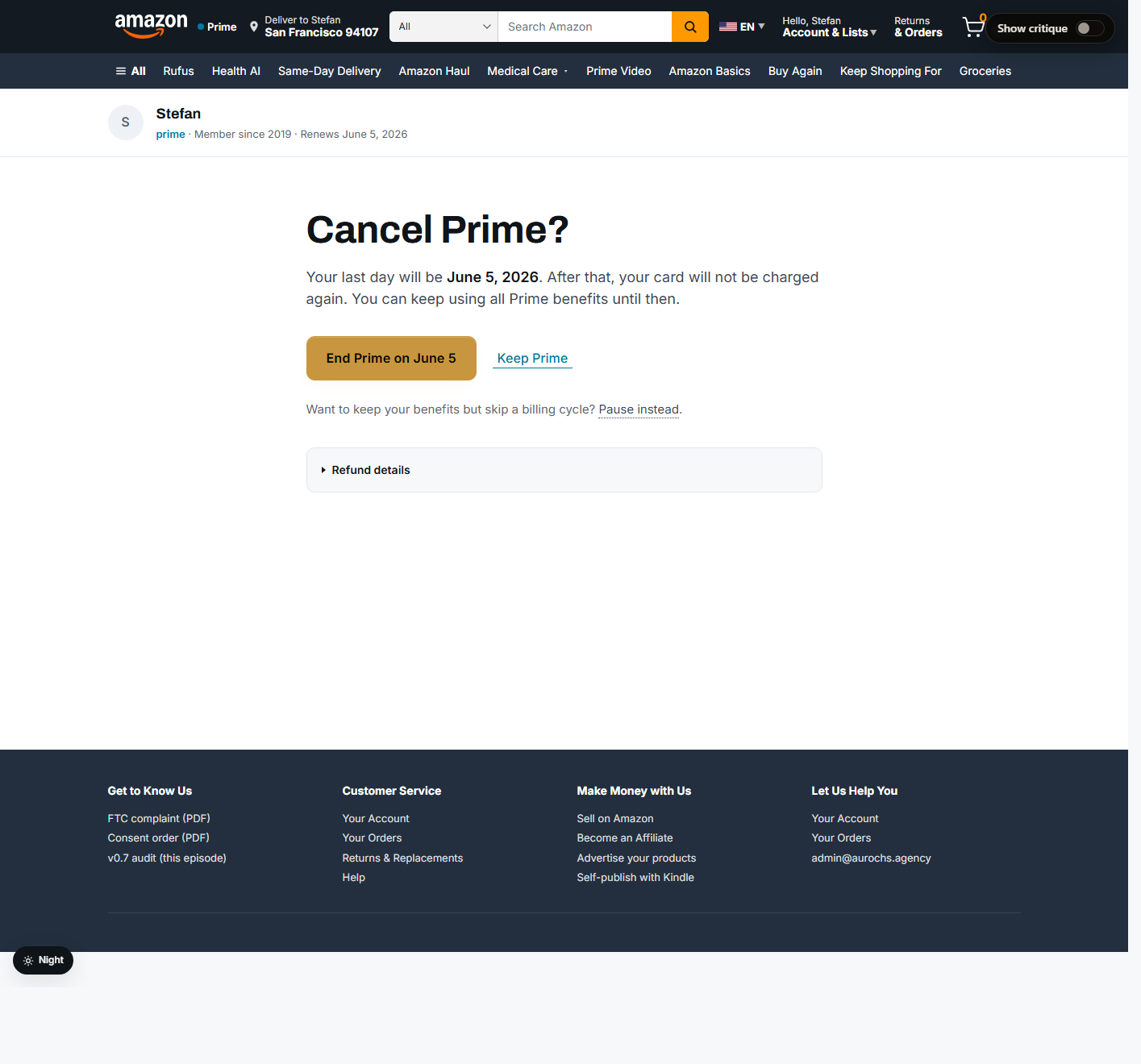
Your last day will be June 5, 2026. After that you will not be charged.
End Prime on June 5 (primary weight) · Keep Prime (link weight, no button chrome).
One sentence below: Pause is also an option if you want to keep your benefits but skip a billing cycle.
Three elements vs eleven. Two paths vs four radios plus two buttons. No sunk-cost carousel. No loss-framed bullet box.
Drag to reveal the rebuild.
The same fold, same resolution, same purpose. Drag the handle horizontally, or use arrow keys when the slider is focused.
Same content. Aligned cancel flow.
"End Prime on June 5." One button, named, dated, primary weight.
The fix, in priority order: L4 path-symmetry, cancel reachable in the same click count as enrollment, end-to-end (not just on the cancel page itself). L3 honesty, no sunk-cost carousel, no loss-framed bullet box, one optional pause link below the cancel button. L1 sincerity, one primary cancel button with a date, one link-weight escape. The September 2025 FTC consent order required compliance at the page level. Amazon delivered that. PFD asks for compliance at the layer level. That ship is still in the harbor.
Real HTML, scrollable, interactive. Flip Show critique in the rebuild's top-right to reveal layer scores, FTC citations, and the cancel-flow reconstruction. Same-origin iframe replaced with a link on 2026-05-06 to keep this audit page lighter, the rebuild stays a click away.
If you scrolled this far, I do this for products. Send me a URL.
Send me your URLSame five-layer scoring. 7-day turnaround. $8K, document you keep.